Charge flipping: Difference between revisions
From Online Dictionary of Crystallography
No edit summary |
No edit summary |
||
| Line 1: | Line 1: | ||
== Definition == | |||
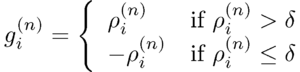
Charge flipping is a structure solution method from the class of [[dual-space phase retrieval algorithms|dual-space algorithms]]. The key component of the charge flipping algorithm is the charge flipping operation. In this operation, all scattering density pixels with density lower than a small positive threshold delta are multiplied by -1 (flipped). In the classical charge flipping algorithm, this direct-space modification is combined with simple resubstitution of structure-factor amplitudes by experimental values, but other modifications and iteration schemes have been proposed and successfully used. | Charge flipping is a structure solution method from the class of [[dual-space phase retrieval algorithms|dual-space algorithms]]. The key component of the charge flipping algorithm is the charge flipping operation. In this operation, all scattering density pixels with density lower than a small positive threshold delta are multiplied by -1 (flipped). In the classical charge flipping algorithm, this direct-space modification is combined with simple resubstitution of structure-factor amplitudes by experimental values, but other modifications and iteration schemes have been proposed and successfully used. | ||
| Line 10: | Line 12: | ||
The iteration cycle then proceeds as follows: | The iteration cycle then proceeds as follows: | ||
# The density <math>\rho^{(n)}</math> is calculated by inverse Fourier transform of <math>F^{(n)}</math>. | |||
# The modified density <math>g^{(n)}</math> is obtained by flipping the density of all pixels with density values below a certain positive threshold <math>\delta</math> and keeping the rest of the pixels unchanged:[[Image:CF_2.png|300px|center]] | |||
#Temporary structure factors <math>G^{(n)}(\mathbf{H})=|G^{(n)}(\mathbf{H})|\exp{(i\varphi_{G}(\mathbf{H}))}</math> are calculated by Fourier transform of <math>g^{(n)}</math>. | |||
#New structure factors <math>F^{(n+1)}</math> are obtained by combining the experimental amplitudes with the phases <math>\varphi_{G}</math> and setting all non-measured structure factors to zero: | |||
[[Image:CF_2.png|300px|center]] | |||
[[Image:CF_3.png|600px|center]] | [[Image:CF_3.png|600px|center]] | ||
These modified structure factors then enter the next cycle of iteration. | These modified structure factors then enter the next cycle of iteration. | ||
Revision as of 13:49, 27 August 2013
Definition
Charge flipping is a structure solution method from the class of dual-space algorithms. The key component of the charge flipping algorithm is the charge flipping operation. In this operation, all scattering density pixels with density lower than a small positive threshold delta are multiplied by -1 (flipped). In the classical charge flipping algorithm, this direct-space modification is combined with simple resubstitution of structure-factor amplitudes by experimental values, but other modifications and iteration schemes have been proposed and successfully used.
Given a trial scattering density [math]\textstyle{ \rho }[/math] sampled on a regular grid, and a set of measured structure-factor amplitudes [math]\textstyle{ F^{obs}(\mathbf{H}) }[/math], the basic charge flipping algorithm follows this scheme:
First, the algorithm is initiated in the zeroth cycle by assigning random starting phases [math]\textstyle{ \varphi_{rand}(\mathbf{H}) }[/math] to all experimental amplitudes and making all unobserved amplitudes equal to zero:

The iteration cycle then proceeds as follows:
- The density [math]\textstyle{ \rho^{(n)} }[/math] is calculated by inverse Fourier transform of [math]\textstyle{ F^{(n)} }[/math].
- The modified density [math]\textstyle{ g^{(n)} }[/math] is obtained by flipping the density of all pixels with density values below a certain positive threshold [math]\textstyle{ \delta }[/math] and keeping the rest of the pixels unchanged:
- Temporary structure factors [math]\textstyle{ G^{(n)}(\mathbf{H})=|G^{(n)}(\mathbf{H})|\exp{(i\varphi_{G}(\mathbf{H}))} }[/math] are calculated by Fourier transform of [math]\textstyle{ g^{(n)} }[/math].
- New structure factors [math]\textstyle{ F^{(n+1)} }[/math] are obtained by combining the experimental amplitudes with the phases [math]\textstyle{ \varphi_{G} }[/math] and setting all non-measured structure factors to zero:


These modified structure factors then enter the next cycle of iteration.